
PricedIn: A Quick Valuation Browser Extension
Reverse Discounted Cash Flow: Working Backwards to Find Value

In the world of investment valuation, the Discounted Cash Flow (DCF) model is king. It is the gold standard for determining the intrinsic value of a company.
In Berkshire’s 1992 annual report, Buffett wrote the classic definition of intrinsic value, which is the essence of DCF:
In the Theory of Investment Value, written over 50 years ago, John Burr Williams set forth the equation for value, which we condense here: The value of any stock, bond or business today is determined by the inflows and outflows – discounted at an appropriate interest rate – that can be expected to occur during the remaining life of the asset.
Later, in the 1996 Owner’s Manual, he defined intrinsic value more simply:
Intrinsic value can be defined simply: It is the discounted value of the cash that can be taken out of a business during its remaining life.
However, it relies heavily on predicting the future. A slight tweak in your growth rate assumptions can wildly swing your valuation from “strong buy” to “strong sell.” Enter the Reverse Discounted Cash Flow (Reverse DCF). Reverse DCF lets you start from price and infer expectations, but until now it required tedious goal-seek math each time.
Instead of trying to predict the future to justify a price, the Reverse DCF starts with the current price to reveal what the market predicts for the future. It is not a crystal ball, but a reality check. While Reverse DCF is easy to understand, it’s hard to calculate. It needs trial and error to match the implied growth at the current price. Mathematically, you are solving the standard DCF equation for the unknown growth rate rather than for present value. I have created a tool called “PricedIn”, which solves this pain of trial and error, it solves the math needed to find the implied growth rate.
PricedIn is a browser extension you can invoke on any stock on any page. As a T-shaped investor, I don’t like an investment if it is not price attractive. So, before I turn another rock, I always check, what is the implied growth rate for the given company. For that purpose, I used to calculate this Reverse DCF on spreadsheet, and that would take several minutes to do the math exercise. PricedIn has simplified the math for me, and hope this free tool does the same for you.
PricedIn is a free browser extension for subscribers that automates Reverse DCF, so you can see implied growth in seconds instead of rebuilding a spreadsheet each time, get PricedIn from this link. This is for investors who already use reverse DCFs and want a fast, expectation-based reality check before going deep on a name.
What is a Reverse DCF?
A standard DCF asks: “Given my assumptions about growth and risk, what is this stock worth?”
A Reverse DCF asks: “Given the current stock price, what growth rate is the market assuming?”
It effectively takes the standard DCF formula and solves for the variable that is usually the hardest to estimate: the growth rate. By isolating the growth rate required to justify the current stock price, investors can judge whether the market’s expectations are realistic, optimistic, or pessimistic.
The Core Logic: Price vs. Value
The philosophy behind Reverse DCF is grounded in “expectations investing.” The current stock price represents the collective consensus of all market participants regarding the company’s future cash flows.
If the Reverse DCF shows the market expects the company to grow at 25% per year for the next decade, but the company has historically only grown at 10%, the stock may be overvalued (priced for perfection).
If the market implies a growth rate of 2% for a company that consistently grows at 8%, the stock may be undervalued (priced for failure).
How to Perform a Reverse DCF
While the math can get complex, the process can be broken down into four main steps:
Identify the Current Price: Start with the current share price of the company. This is your known variable.
Estimate Free Cash Flow (FCF): Determine the company’s current Free Cash Flow (Operating Cash Flow minus Capital Expenditures). This serves as the baseline for the calculation.
Determine the Cost of Capital (WACC) / Discount Rate: Estimate the Weighted Average Cost of Capital (WACC). This is the required rate of return or the discount rate for the business to make sense as an investment. It represents the risk associated with the investment. This can simply be set to your desired IRR (required rate of return).
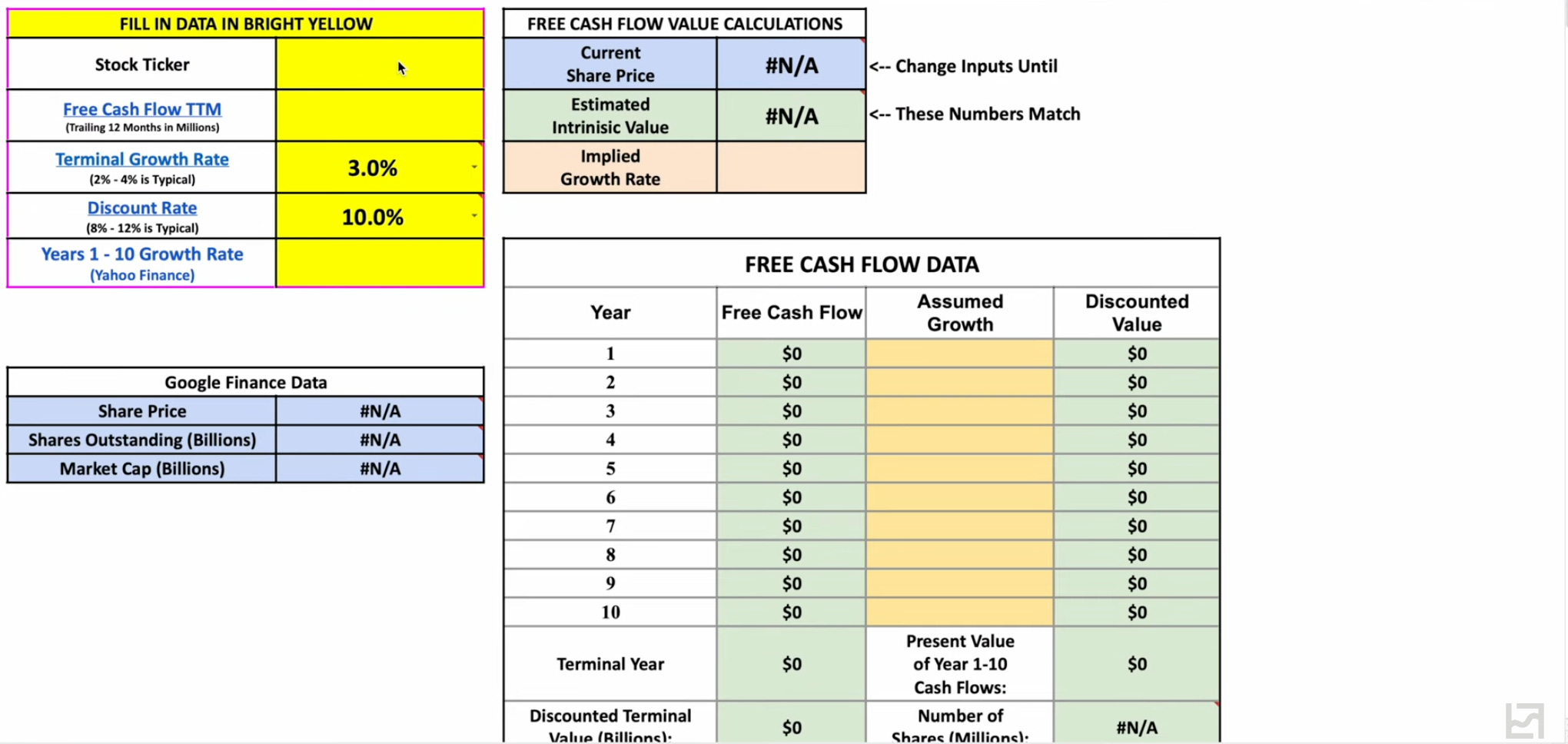
Solve for Growth: In a standard DCF, you input a growth rate to find the value. In a Reverse DCF, you use algebra (or a spreadsheet “Goal Seek” function) to find the Implied Growth Rate that equates the future cash flows to the current stock price. I took the following snapshot from Long Term Mindset youtube channel. PricedIn plugin is designed to achieve the reverse DCF analysis at a minimal effort.
Real-World Example: Adobe (ADBE)
At the time of writing:
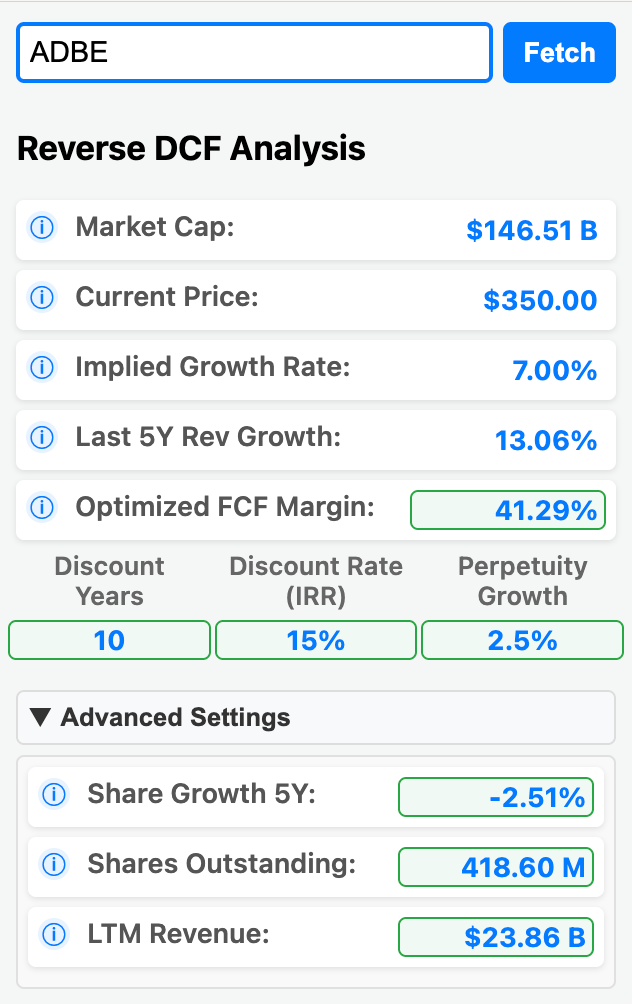
Market Cap : $146B
Share price at the time of writing: $150
Shares outstanding: 418.6M
LTM Revenue: $23.86B
Shares growing (shrinking): -2.51%
If we assume the LTM FCF margin 41.29% continues for next 10 years, then for 15% annual return ADBE needs to grow the revenue at only 7% rate. Growth at perpetuity after 10 years, is only at 2.5%. Given than ADBE has been growing revenue much faster last 5Y (13.6%), ADBE might easily be very attractive at this price.
Apply PricedIn Magic
When you come across a new name, just right click the ticker or click PriceIn plugin and enter your ticker. Once you click Fetch, it already pre-populates with all recent metrics and gives you one implied growth assumed in the current price. Optionally, you can enter an estimated optimized FCF margin, different discount rate/ year, or perpetuity growth.
This turns Reverse DCF into a screening tool you can use multiple times per day, not just an occasional spreadsheet exercise.
Advantages of Reverse DCF
Removes Bias: Standard DCFs are prone to confirmation bias. You can unconsciously tweak the growth rate until the spreadsheet gives you the number you want. Reverse DCF forces you to confront the market’s number first.
Focuses on Probability: Instead of asking “How much is this worth?”, it forces you to ask “How likely is it that they can grow at X%?” This is often a much easier question to answer.
Sanity Check: It is an excellent tool for screening. If you find a stock you like, run a quick Reverse DCF using free tools like PricedIn. If the implied growth is astronomical, you know you need a very strong thesis to justify buying.
Limitations
Like any model, Reverse DCF is not perfect.
Garbage In, Garbage Out: If your estimate for current Free Cash Flow, or optimized Free Cash Flow is wrong, the implied growth rate will be wrong.
Short-Term vs. Long-Term: It assumes the market prices stocks purely on long-term cash flows, ignoring short-term sentiment, momentum, or liquidity issues.
Cyclical Industries: It struggles with cyclical companies (like commodities) where current cash flows might be at a peak or trough, distorting the baseline.
Conclusion
The Reverse DCF is a tool for the skeptic. It allows an investor to deconstruct the stock price and look under the hood of market sentiment. By revealing the growth expectations embedded in a stock price, it helps investors differentiate between a great company and a great investment.
In a market often driven by hype, the Reverse DCF is your anchor to reality.
© 2025 InsightButter LLC. All rights reserved.
All content published on Multibagger Insights, including articles, newsletters, comments, and any other materials (collectively, “Content”), is provided for educational purposes only and for general informational use.
The Content is not, and should not be construed as, investment advice, financial advice, or a recommendation to buy, sell, or hold any security or other financial instrument. We do not provide personalized financial planning or investment services. Always consult with a qualified financial professional before making any investment decisions. Reliance on any information provided by Multibagger Insights or its authors is solely at your own risk.